2026 Construction Material Prices Are A Killer - Here's How to Fight Back


2026 is bringing a storm of construction material price volatility that is set to turn fixed-bid contracts into a wrecking ball for your margins. The old way of buying construction materials - relying on the spot market and messy spreadsheets - is a fool's game. Learn how to stop bleeding cash and start treating your procurement as armor for your bottom line.
The Grit To Survive Materials Pricing Volatility
For construction companies, 2025 has brought a storm that took grit to survive. Volatility in materials costs sunk the profitability of many projects.
The calm stability of material pricing that lasted for a little while is gone, replaced by a volatility driven by forces far outside the job sites: tariffs, geopolitical trade wars, and the voracious appetite of the tech industry’s data centers.
2026 is bringing more of this storm. The old ways of procuring materials for construction are colliding with a new economic reality.
The Recent History of Materials Pricing Promises A Wild 2026
We need to talk about what materials are going to cost in 2026. But first, let’s ask something about the year 1920? Look around your office. Does this place feel like a sharp, modern operation, or does it too often feel like you’re still running parts of the business like a 1920s back office? Is construction materials procurement part of that?
Previous Construction Procurement Software Didn’t Work
At Field Materials, we hear that from folks: Out in the field, we've got drones, fancy BIM models, laser scanners; all high-tech tools. However, when a material order hits this office, it is old school again. You may have tried some OCR-based invoice scanning but it didn’t work so it was back to piles of paper and spreadsheets.
Materials Pricing in 2026
Here's the biggest difference between 2026 and 1920: Back then, materials were cheap as dirt. Today, materials are one of the biggest risks on your balance sheet.
For the teams working on fixed-bid contracts, the new environment is a meat grinder. We’ve seen a flagship project turn into a loss-leader before they even fired up the first piece of heavy equipment, all because of a material price swing.
Field Materials Analysis
Now, we didn't just sit here and guess which way the wind was blowing. At Field Materials, we actually looked at the books. For this report, we analyzed hundreds of million dollars in annualized material spend across over 10,000 projects and 13,000 vendors.
In our recent market breakdown, we're seeing clear signs that key materials in Mechanical, Electrical, and Civil trades are set for some serious price hikes in 2026. Whether it’s copper wire, specialized valves, or even basic concrete components, you can forget about flat, predictable pricing. Those days are done, or at least on a long vacation.
The Data Doesn't Lie: Inflation by Trade
The talking heads keep yapping about "general inflation" on the news, but out here on the job site, it's a whole different ball game. Field Materials AI data shows the pain isn't spread out nice and neat, it's hitting some trades like a two-by-four. If you're banking on prices cooling off, you're gonna be waiting 'til the cows come home.

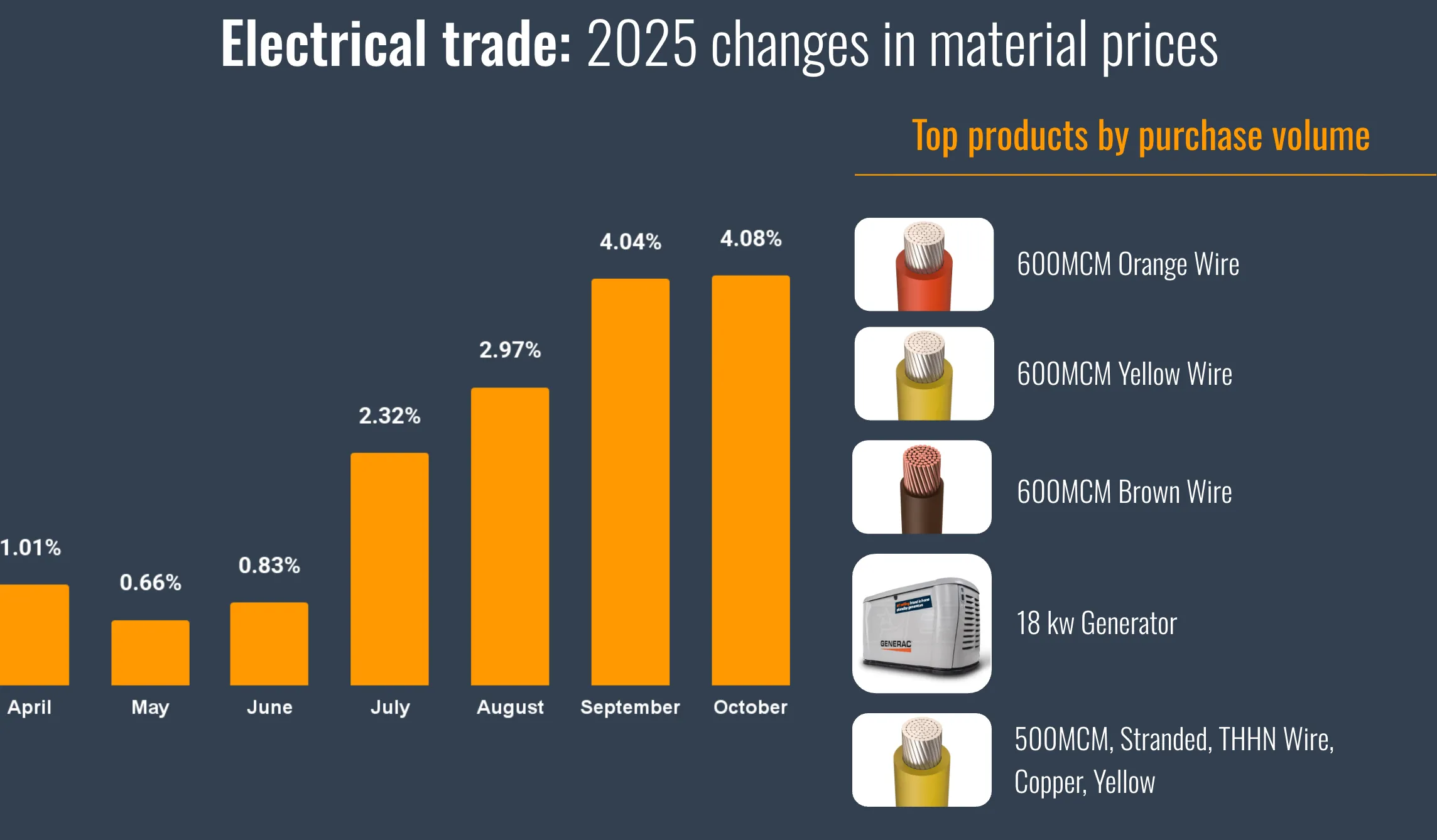
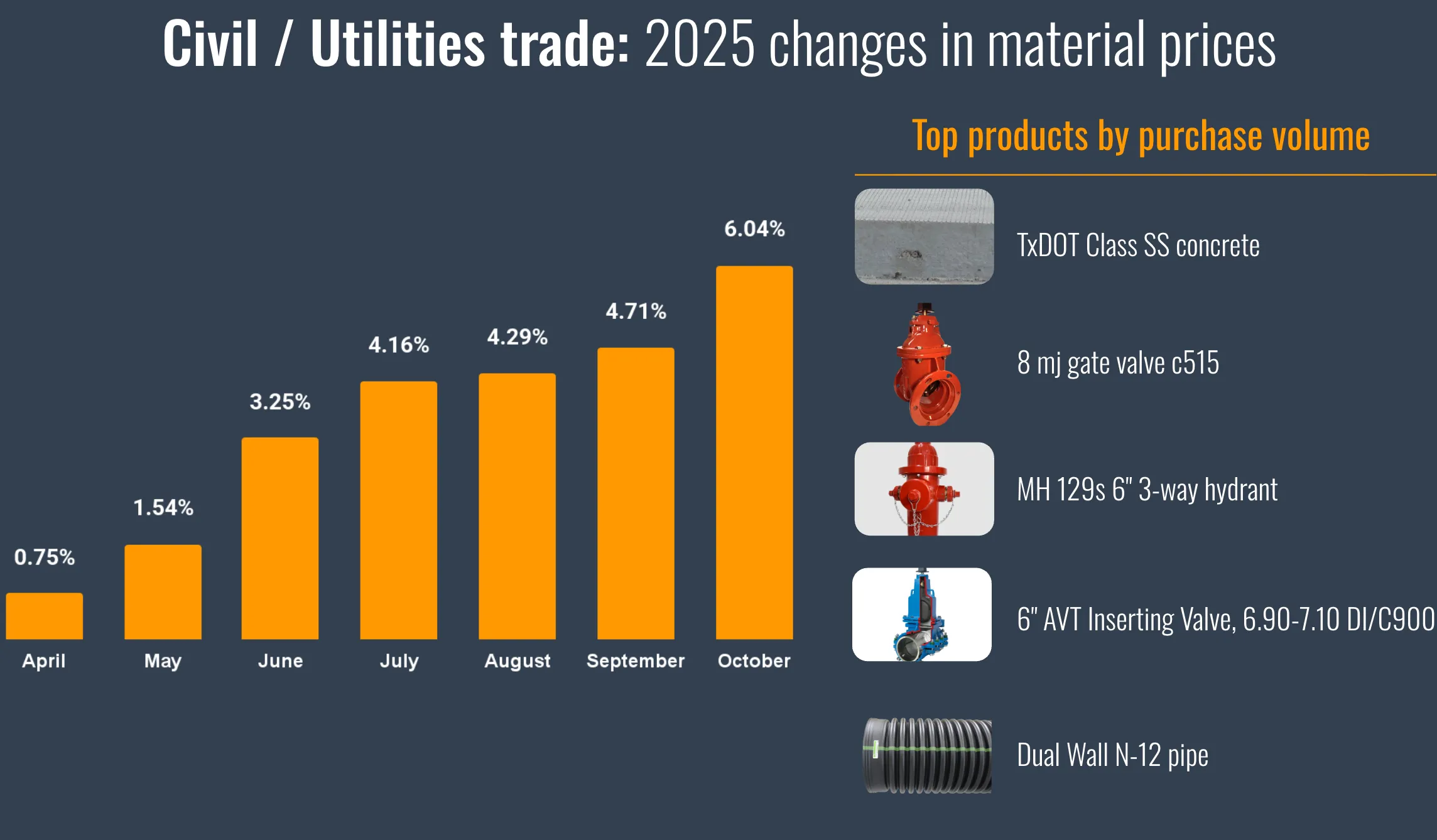
We crunched the numbers across a billion dollars’ worth of actual orders. Here the straight dope from 2025 data:
- Mechanical Teams: You're seeing a slow, steady climb, roughly 6.6%. That's way more than what the government's talking about.
- Civil Work (Dirt Movers): Same deal. You're staring down a steady 6% jump.
- Electrical Crew: You've been on a roller coaster. Overall, prices are up about 4%, but that doesn't tell the whole story. They actually dipped in the spring, then spiked hard once summer hit. You gotta watch your backside with this stuff.
Levers You Can Pull Right Now
While you can’t fix the economy, you can fix your house. To get through this mess of material prices without bleeding cash, the good outfits are leaning hard on a few specific things.
The Buyout Defense
When you’re running a big commercial job, you don't mess around with the spot market unless you're desperate. That's a fool's game right now. You need to get your buyouts set up yesterday. Lock that price in for the whole project. This sounds like 'duh,' right? But where this messes up is when you don't police the drawdown. They get the price locked, but then the guys in the field just call stuff in, and the supplier happily bills us at today's inflated rate. Your job is to set up a system that holds that supplier's feet to the fire on every single invoice.
Now, if a supplier won't play ball on a full buyout, hit them with a NRFR- a Not Ready For Release purchase. That's where you buy now but schedule the delivery for when you’ll need the materials in the future. We'll talk more about how to run those below.
Crush Rogue Spending
Let’s talk about rogue spending - that’s the technical term for guys going cowboy with the company card.
It's when a foreman, in a rush because the clock's ticking and he needs to get a task done, goes outside the normal process. It happens in every trade, from the dirt guys to the drywall crews.
Say a crew is hanging rock, and they run short on a box of screws. The foreman can't wait for the office to cut a P.O.. So, he hauls fast to the nearest supply house, puts it on the company tab, and scribbles the job name on the back of the ticket. Problem is, he's paying the full counter price, not your negotiated contract rate. Right off the bat, that's an extra 5 to 10 percent we just threw away.
And worse, what's the next thing the foreman does? He tosses that receipt in the glovebox - what we at Field Materials call the Glovebox Graveyard. That ticket is a time bomb. It probably doesn't have the right cost code, it dodged your pricing, and when it lands on the desk of your poor AP team it becomes a major headache.
The mess continues back in the office. Because there was no P.O. set up ahead of time, the invoice shows up like an orphan. Accounts Payable just codes it to some general bucket like "Misc." Now, your job cost report is garbage.
Even worse, if you don't know he bought it, the office might turn around and order the same damn thing again. That's how you end up with excess material piled up in the yard as waste
The secret to killing this cowboy spending is simple: you have to capture what's being bought in the field, as it happens, and get that information into the office's system instantly. That's the only way we keep the project running lean and mean.
Stock Up Inventory: Treat Your Warehouse Like a Vendor
If you have the warehouse space and the cash flow, stock up when prices are low. Don't wait for a project to start to buy your commodities.
Use your purchasing data to identify your top-moving items - whether that's specific 600MCM wire for your electrical jobs or standard duct liner for mechanical work - and negotiate a bulk price.
Treat your warehouse like a vendor to your own jobs. When prices spike in the summer, your projects "buy" from your warehouse at the lower, locked-in rate. This isn't just storage; it is a financial hedge that protects your margins from market volatility.
A word of caution: This strategy is a goldmine for MEP, Fireproofing, and Insulation contractors where materials are smaller and high-volume. If you are in Civil (precast pipes) or Framing (steel studs), this lever is likely not for you - the cost of storing bulky materials will eat up the savings. Know your trade's limitations.
Negotiate From A Position Of Strength
Most contractors walk into vendor negotiations blind. They ask for a discount based on a relationship, or they bid out a single job and hope for the best. That is leaving money on the table.
To win in 2025, you need to stop buying like a consumer and start negotiating like a corporation.
With Field Materials Pricing Intelligence module, you can instantly aggregate your data to see exactly how much you buy of each material across all your projects in a year. You might find that while you only need 5,000 feet of conduit for this job, you actually bought 200,000 feet from that vendor last year.
That data changes the conversation. You walk into the meeting with facts:
- "We spent $2M with you last year."
- "We bought 500 units of this specific fixture."
When you have a clear understanding of your total volume, you can demand volume pricing tiers and yearly rebates that you simply cannot get when you negotiate job-by-job. More on Field Materials pricing intelligence below.
The "Seasonal Volatility" Lever: When to Buy
One of the most crucial insights from our data is the Seasonal Volatility Factor. Construction material prices aren't random; they follow a rhythm. Historically, prices surge in the summer when building activity peaks and subside in the winter.
The Strategy: Buy in The Winter
Use the winter months (November through January) to lock in your bulk purchases. This is your window of opportunity to hedge against the inevitable spring/summer price hike.
How to Lock Pricing Without Flooding Your Yard
"But I can't store all that material!"
We hear this objection constantly. You want to buy early to beat the 6.6% inflation, but you don't have the warehouse space.
The Tactic: Not Ready for Release (NRFR)
Smart purchasing managers are using the "Not Ready for Release" tactic. You issue a Purchase Order for the full amount of the material now to lock in the price, but you explicitly schedule the delivery dates for later in the project. You own the price today; you take the material when you need it.
The Reality Check on Inventory - Be realistic about what you stock.
- Don't Stock: Bulky items like steel studs (Framing) or precast pipes (Civil). The storage costs eat your savings.
- Do Stock: High-volume, small-footprint items like MEP consumables, fittings, fireproofing, and wire. This is where inventory arbitrage actually protects your profit.
The Tech Solution - AI Agents
Look, you can't hire your way out of this storm, and God knows another spreadsheet isn't going to fix a bleed in your cash flow. When materials are eating your profit margin alive, the answer isn't throwing more bodies at the problem; it's bringing in the heavy machinery of specialized Artificial Intelligence (AI).
Right now, the truth about your costs is buried in a paperwork nightmare: receipts shoved in a cabinet folder, delivery tickets crinkled in a vest pocket or lost in the Glovebox Graveyard.
You need AI agents that act like a relentless project manager. These agents need to read every scrap of paper, track every stick of conduit, and instantly check the price against the quote you fought for.
Most importantly, it has to work for the guys actually building the job. If it’s complicated, the field won't touch it. It’s gotta be fast and dead simple for the foreman in the truck, while still digging deep enough to feed accurate data straight into your accounting system back at the office.
Field Materials is AI built specifically for construction procurement
So, how do you solve the paperwork crisis? You need a tool built specifically for this problem.
Field Materials AI is the AI built specifically for construction procurement.
Field Materials AI is not OCR. It is based on Large Language Models built and trained from the ground up for construction companies. Legacy OCR looks for pixels in a specific spot. If the vendor changes their font or even paper size, OCR breaks.
Field Materials reads the document like a human would. It understands that "Qty" means "Quantity." It knows that a scribbled note from a foreman saying "5 boxes" needs to be converted to "250 linear feet" to match the vendor's invoice unit.
With AI Vision, the Field Materials app can:
- Look at a messy quote from a lumber yard and understand that the rows of text are line items.
- Look at a crumpled packing slip photo from a job site and match it to the original PO, flagging that you only received 400 feet of pipe instead of 500.
- Read an invoice and automatically code it to the right job and cost code without a human touching the keyboard.
Field Materials learns your business, automates the grunt work, and flags the errors that human eyes miss - all without you having to template any invoice or doc. And, Field Materials does this for both paper and emails. With emails, Field Materials can just watch an inbox and automatically process any docs that email inbox receives.
From Data Entry to Pricing Intelligence
Once you stop drowning in data entry, you can start using the new Pricing Intelligence module for Field Materials AI.
Like discussed above, most contractors walk into vendor negotiations blind. They ask for a discount; they don't justify it. With the Field Materials Pricing Intelligence module, you walk in with a dashboard:
- "We spent $X with you last year."
- "We see that we paid $X for this SKU in May and $Y in August."
You move from processing POs to managing spend!
Take Control in 2026
Next year, 2026? It’s gonna be a nasty year for the cost of goods. Copper, steel, concrete - the core stuff we build with - it’s all heading north.
But here’s the secret the amateurs don’t get: This ain't an excuse; it's a chance. If you lock down your deals in advance, if you enforce every buyout like it's gospel, and if you finally ditch those cursed spreadsheets and use the AI to stop the invisible tax of wasted time, you won't just survive this mess, you’ll thrive.
Don't wait for the newspapers to tell you about the next tariff. Fix the leaky boat today. Get your construction procurement ducks in a row and let's make sure we're ready for whatever 2026 tries to throw at you.

.webp)